Activation Cells Also Grow
Compare fixed parameter storage against batch-scaled hidden activation tensors retained in memory during training.
The problem
Counting model parameters often creates a false sense of safety about memory. Suppose a compact four-layer network has width vector [8, 16, 16, 16, 2]: input features, three hidden layers of width , and output logits. Its weights and biases fit in fewer than a thousand scalars, yet training on a large mini-batch can still exhaust device RAM on deeper versions of the same pattern.
Why? During training, backpropagation must retain every hidden layer's forward activations across all rows of the current mini-batch until the backward pass consumes them. How do fixed parameter cells compare against stored hidden activation cells as batch_size grows?
Work through the numbers
Count trainable parameters across the four dense transitions in [8, 16, 16, 16, 2]. Layer () holds parameters. Layer () holds parameters. Layer () holds another parameters, and Layer () holds parameters.
Adding gives 722 parameter cells. Because weights are shared across every row in a batch, that 722-cell footprint stays constant whether batch_size is or .
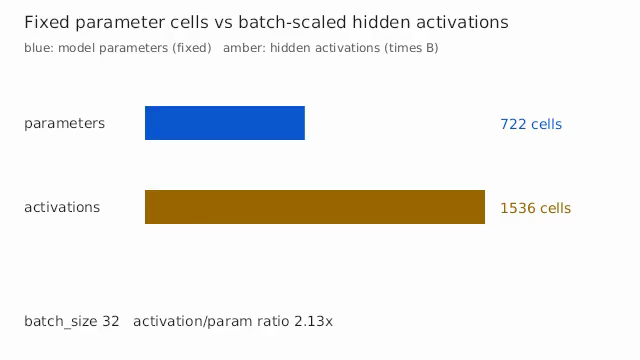
Now count hidden activation cells across the interior widths [16, 16, 16]. One example produces hidden values. At the default batch_size , storing those three hidden tensors requires cells, giving [722, 1536]: hidden activations occupy more than twice the space of the weights themselves.
The live model
The blue bar shows fixed parameter cells (722) and the amber bar shows batch-scaled hidden activation cells across [8, 16, 16, 16, 2]. At batch_size , activations take 192 cells, well below 722. At batch_size , activations reach 576 cells; at batch_size they hit 768 cells and overtake the parameter budget. At the default they reach 1,536, and at they climb to 3,072 cells.
let batch_size = scene.parameter("batch_size", 32.0, 4.0, 64.0, 4.0);
let n = input.size(0);
let d_in = input.slice(0, 0, n - 1);
let d_out = input.slice(0, 1, n);
let p_cells = ((d_in + 1.0) * d_out).sum();
let hidden = input.slice(0, 1, n - 1);
let a_cells = hidden.sum() * batch_size;
let pair = torch.list().add(p_cells.reshape(1)).add(a_cells.reshape(1));
let answer = torch.cat(pair, 0);
out.set("params_vs_activations", answer);
{
  "params_vs_activations": [
    722,
    1536
  ]
}
Watch the parameter change
Your turn
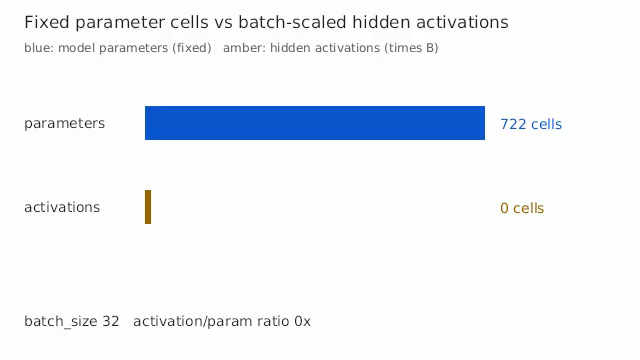
In the starter program, the parameter count (p_cells) is already computed for [8, 16, 16, 16, 2], while the hidden-activation slot is a zero placeholder ([722, 0]). Set answer to [parameter_cells, hidden_activation_cells] retained across the interior hidden layers during training; Check tests both the default [8, 16, 16, 16, 2] network at batch_size = 32 ([722, 1536]) and unseen depth, width, and mini-batch combinations.
let batch_size = scene.parameter("batch_size", 32.0, 4.0, 64.0, 4.0);
let n = input.size(0);
let d_in = input.slice(0, 0, n - 1);
let d_out = input.slice(0, 1, n);
let p_cells = ((d_in + 1.0) * d_out).sum();
let a_cells = torch.zeros(1).to(DType.F64);
let pair = torch.list().add(p_cells.reshape(1)).add(a_cells.reshape(1));
let answer = torch.cat(pair, 0);
out.set("params_vs_activations", answer);
{
  "params_vs_activations": [
    722,
    0
  ]
}
Return [parameter_cells, hidden_activation_cells] for the width vector input at the active batch_size.
Read the result carefully
Solve for the exact crossover batch size on [8, 16, 16, 16, 2]: dividing , so is the first integer batch size where stored hidden activations exceed parameters (768 versus 722).
Notice the operational difference between inference and training. Inference can overwrite one hidden buffer as each layer finishes because no backward pass follows, whereas standard training must keep every intermediate activation tensor alive until gradients propagate back to the start.
Recap
- Parameter storage sums across layers and remains fixed regardless of mini-batch size .
- Training retains hidden activation tensors for backpropagation, consuming times the sum of interior hidden widths.
- Increasing
batch_sizelinearly inflates activation memory, quickly overtaking parameter memory even on narrow networks.