When Rates Can Be Negative, the Normal Model
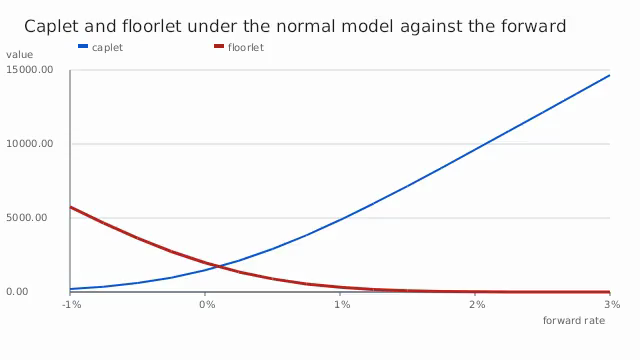
Black's formula has no answer for a negative forward rate; the normal model moves the rate by an absolute amount, so a caplet and a floorlet can be priced at any forward. The program draws both against the forward and compares the two models at the money.
The question
Black's formula takes the logarithm of forward over strike, and a negative forward has no logarithm. When a forward rate is below zero, which the made-up inputs of this lesson allow, the formula has nothing to say. Is there another way to price a caplet or a floorlet then?
The normal model, also called Bachelier's model (the engine's call is pricing.bachelier), lets the rate move by an absolute amount: the forward rate at the fixing is the forward today plus a normal random amount with a standard deviation s times the square root of the time. A negative forward is no problem for it.
Work it by hand
Write F for the forward, K for the strike, T for the time to the fixing and s for the normal volatility, an amount of rate per square root of a year. With d equal to F minus K, divided by s times the square root of T, the call is D times ((F minus K) N(d) plus s square root of T times the normal density at d), and the put is the call minus D times (F minus K).
- Take F equal to minus 0.2%, K equal to 0.1%, s equal to 0.6% and T equal to 2 years. The standard deviation s square root of T is 0.8485%.
- d is minus 0.3% divided by 0.8485%, which is minus 0.3536: the forward is a third of a standard deviation below the strike.
- The caplet is still worth something, because the rate may rise above the strike before the fixing. The floorlet is worth more.
Near the money the two models agree when the normal volatility is about the forward times the Black volatility: for a forward and strike of 4%, an expiry of 1 year, a discount factor of 0.96 and a Black volatility of 20%, a normal volatility of 0.8% gives almost the same price: for the demo's notional and accrual, 1,531.94 in the normal model and 1,529.39 in Black's.
Run it
The program takes strike, normal_vol, expiry, discount, notional, accrual and a forward that may be negative. Line 1 multiplies notional and accrual. The loop on lines 4 to 10 prices a caplet with pricing.bachelier("call", ...) and a floorlet with "put" at 17 forwards from -1% to 3%, through zero. Line 11 prices the caplet at the input forward, and line 13 gives d.
Lines 14 and 15 price one at-the-money caplet in each model, with a normal volatility of 0.8% and a Black volatility of 20%. The program returns the caplet at the input forward in whole cents.
Watch the steps (recorded video)
let scale = notional * accrual;
let forwards = float_list(); let caplets = float_list();
let floorlets = float_list();
for (i in range(0, 17)) {
  let f = 0.0 - 0.01 + 0.0025 * float(i);
  let c = pricing.bachelier("call", f, strike, normal_vol, expiry, discount);
  let p = pricing.bachelier("put", f, strike, normal_vol, expiry, discount);
  forwards.add(lmf.round(f, 6)); caplets.add(lmf.round(scale * c, 2));
  floorlets.add(lmf.round(scale * p, 2));
}
let c0 = pricing.bachelier("call", forward, strike, normal_vol,
  expiry, discount);
let sd = normal_vol * math_sqrt(expiry); let d = (forward - strike) / sd;
let normal = pricing.bachelier("call", 0.04, 0.04, 0.008, 1.0, 0.96);
let black = pricing.black76("call", 0.04, 0.04, 0.2, 1.0, 0.96);
lmcode_return_put("forwards", forwards);
lmcode_return_put("caplets", caplets);
lmcode_return_put("floorlets", floorlets);
lmcode_return_put("caplet", lmf.money(scale * c0));
lmcode_return_put("d", lmf.round(d, 4));
lmcode_return_put("normal_atm", lmf.money(scale * normal));
lmcode_return_put("black_atm", lmf.money(scale * black));
let answer = int(math_round(lmf.round(scale * c0, 2) * 100.0));
{
  "answer": 105774,
  "forwards": [
    -0.01,
    -0.0075,
    -0.005,
    -0.0025,
    0,
    0.0025,
    0.005,
    0.0075,
    0.01,
    0.0125,
    0.015,
    0.0175,
    0.02,
    0.0225,
    0.025,
    0.0275,
    0.03
  ],
  "caplets": [
    196.6,
    355.83,
    604.91,
    969.14,
    1468.85,
    2114.89,
    2906,
    3829.15,
    4862.64,
    5980.75,
    7158.45,
    8374.66,
    9613.72,
    10865.23,
    12122.96,
    13383.55,
    14645.35
  ],
  "floorlets": [
    5751.6,
    4648.33,
    3634.91,
    2736.64,
    1973.85,
    1357.39,
    886,
    546.65,
    317.64,
    173.25,
    88.45,
    42.16,
    18.72,
    7.73,
    2.96,
    1.05,
    0.35
  ],
  "caplet": "1,057.74",
  "d": -0.3536,
  "normal_atm": "1,531.94",
  "black_atm": "1,529.39"
}
You can change all seven inputs. The normal volatility, the expiry and the discount factor must be positive, or line 6 stops with "pricing.bachelier: vol must be positive, got 0", "pricing.bachelier: expiry must be positive, got 0" or "pricing.bachelier: discount must be positive, got 0". The strike and the forward may be negative or zero. Black's formula refuses the demo's forward: pricing.black76 with it stops with "pricing.black76: forward must be positive, got -0.002 (use pricing.bachelier for a negative forward)".
Your turn
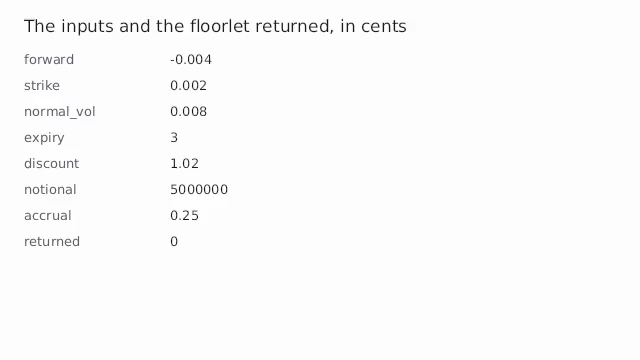
The program below is meant to return the value of a floorlet under the normal model in whole cents, for a forward rate that may be negative and a positive strike: notional times accrual times the Bachelier put price with the given normal volatility, expiry and discount factor. Decide whether it does, and find the candidates that do. Check runs each candidate on the data shown and on five others.
let scale = notional * accrual;
let flat = math_abs(forward);
let unit = pricing.black76("put", flat, strike, normal_vol, expiry, discount);
let answer = int(math_round(lmf.round(scale * unit, 2) * 100.0));
{
  "answer": 0
}
A floorlet has the given notional and accrual, a forward rate that may be negative, a positive strike, a normal volatility (an amount of rate per square root of a year), a time to the fixing in years and a discount factor. Return its value in whole cents under the normal model: notional times accrual times the Bachelier put price. Round the result to cents.
Read the result carefully
Both models are models of one rate at one date, and neither is the price. The normal model allows any negative rate, however low, and also a positive rate to fall far below zero; the lognormal one allows none. A discount factor above 1, such as the 1.01 of the demo, is what negative rates mean in this model; it is a made-up input.
The engine's caps and swaptions, pricing.capfloor_npv and pricing.swaption_npv, use Black's formula only: there is no normal engine for the dated instruments, and this lesson uses typed-in numbers. The numbers come from made-up inputs and say nothing about any market. It is a description of an arithmetic model and not investment advice.
Recap
- The normal model prices a rate option at any forward, negative or not.
- In the normal model the call is D times ((F minus K) N(d) plus s root T times the density at d), with d equal to (F minus K) over s root T.
- Near the money the two models agree when the normal volatility is about the forward times the Black volatility.
- The floorlet is the caplet minus D times (F minus K), as in the parity of the first chapter.