Payer Minus Receiver Is a Forward Swap
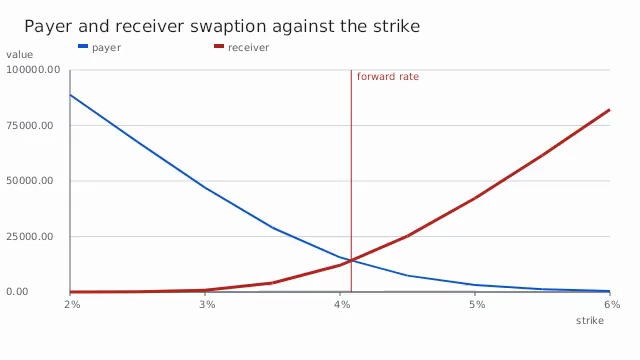
A payer swaption minus a receiver swaption with the same strike is the annuity times the forward swap rate minus the strike, the value of a forward swap, whatever the volatility; the engine prices both, and the program draws them against the strike and checks the identity.
The question
A payer swaption is the right to pay the strike and receive the floating rate on a swap. A receiver swaption is the right to receive the strike and pay the floating rate. Hold the payer and write the receiver, with the same strike, the same expiry and the same swap. What do you hold?
If at the exercise date the swap rate is above the strike, the payer is exercised and the receiver is not; below it, the receiver is exercised against you and the payer is not. Either way you end up paying the strike and receiving the floating rate: a forward swap, agreed today and starting at the exercise date. This is put-call parity for swaptions, the same identity as for caplets and caps, with the annuity as the weight.
Work it by hand
The forward swap that pays the strike K and receives the floating rate is worth the annuity A times the difference of the forward swap rate F and K. So payer minus receiver equals A times F minus K, for any volatility.
- When the strike equals the forward swap rate the difference is zero: the payer and the receiver cost the same.
- When the forward swap rate is above the strike, the payer costs more; when it is below, the receiver does.
- The annuity A includes the notional and the discounting to today, as in the last lesson.
For the demo, with the one-year option on the five-year swap, a strike of 4% and a flat curve at 4%, the forward swap rate is a little above the strike, so the payer costs more than the receiver. The returned values show both prices and the annuity times F minus K; the first two differ by exactly the third.
Run it
The program takes notional, strike, the flat continuous rate, vol and the whole years expiry and tenor. The loop on lines 5 to 11 builds a payer swaption and a receiver swaption, made with Swap.receiver(), at nine strikes from 2% to 6% and keeps their prices. Lines 12 and 13 do the same at the input strike.
Lines 14 to 16 ask the engine for the forward swap rate and the two prices, and line 17 computes the annuity times the forward rate minus the strike. The program returns payer minus receiver minus that gap in whole cents. It is 0 for every input of ordinary size. Both sides are the engine's values on the evaluation date 2025-01-02, and Check compares that residual.
Watch the steps (recorded video)
market.set_date("2025-01-02");
let curve = market.flat_curve(rate);
let t = float(tenor); let e = float(expiry);
let payers = float_list(); let receivers = float_list();
for (i in range(0, 9)) {
  let k = 0.02 + 0.005 * float(i);
  let p = instrument.swaption(instrument.swap(notional, k, t), e);
  let r = instrument.swaption(instrument.swap(notional, k, t).receiver(), e);
  payers.add(lmf.round(pricing.swaption_npv(p, curve, vol), 2));
  receivers.add(lmf.round(pricing.swaption_npv(r, curve, vol), 2));
}
let pay = instrument.swaption(instrument.swap(notional, strike, t), e);
let q = instrument.swaption(instrument.swap(notional, strike, t).receiver(), e);
let forward = pricing.swaption_forward_rate(pay, curve);
let p1 = pricing.swaption_npv(pay, curve, vol);
let r1 = pricing.swaption_npv(q, curve, vol);
let gap = pricing.swaption_annuity(pay, curve) * (forward - strike);
lmcode_return_put("payers", payers);
lmcode_return_put("receivers", receivers);
lmcode_return_put("forward", lmf.round(forward, 6));
lmcode_return_put("payer", lmf.money(p1));
lmcode_return_put("receiver", lmf.money(r1));
lmcode_return_put("annuity_gap", lmf.money(gap));
let answer = int(math_round(lmf.round(p1 - r1 - gap, 2) * 100.0));
{
  "answer": 0,
  "payers": [
    88864.55,
    67599.32,
    47002.05,
    28950.98,
    15582.6,
    7376.05,
    3125.26,
    1210.07,
    436.53
  ],
  "receivers": [
    1.08,
    62.84,
    792.56,
    4068.47,
    12027.08,
    25147.51,
    42223.71,
    61635.5,
    82188.95
  ],
  "forward": 0.040834,
  "payer": "15,582.60",
  "receiver": "12,027.08",
  "annuity_gap": "3,555.52"
}
The picture draws the payer and the receiver against the strike, with a mark at the forward swap rate where they cross. It always covers strikes from 2% to 6%: with a rate such as 0.07 the forward swap rate is outside that range, and the curves do not cross in the picture.
You can change the inputs, with the limits of the last lesson. A notional of 0, a tenor outside 1 to 100, an expiry above 50 years or a volatility of 0 stop line 9 in the loop, with "swap notional must be positive", "swap maturity must be a whole number of years, 1 to 100", "swaption expiry must be a whole number of months, up to 50 years" or "swaption volatility must be positive".
An expiry of 0 stops line 7 with "swaption expiry must be positive". A strike of 0 does not stop the program.
A negative strike stops line 15 with "strike + displacement (-0.01 + 0) must be non-negative" (for -0.01), and a flat rate of 0 or below stops line 9 with "forward + displacement (-0.00995559 + 0) must be positive" (for -0.01; a rate of 0 shows a tiny negative number in place of -0.00995559). With a notional of 1e16 the values are too large for binary numbers to hold their cents, and the residual is 15 cents instead of 0.
Your turn
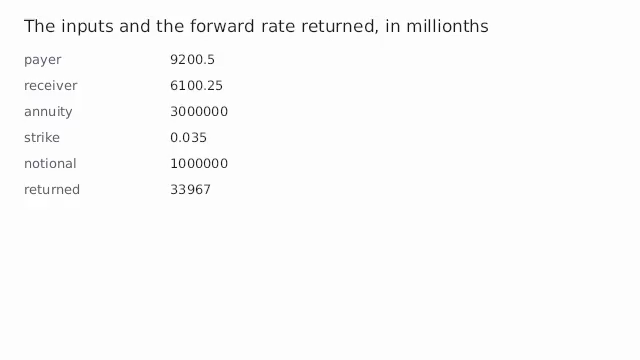
A payer swaption of some strike is quoted at payer and the receiver swaption of the same strike, expiry and swap at receiver. The annuity of the swap, which already includes the notional and the discounting, is annuity. The program below is meant to return, in whole millionths, the forward swap rate that these quotes imply. Decide whether it does, and find the candidates that do. Check runs each candidate on the data shown and on five others.
let gap = receiver - payer;
let forward = strike + gap / annuity;
let answer = int(math_round(lmf.round(forward, 6) * 1000000.0));
{
  "answer": 33967
}
A payer swaption and a receiver swaption have the same strike, expiry and swap. They are quoted at payer and receiver, in money. annuity is the annuity of the swap in money, including the notional and the discounting; notional is the swap's notional. Return, in whole millionths of a rate, the forward swap rate that the two quotes imply by parity, with strike as a rate. Round to millionths.
Read the result carefully
As for caplets and caps, the parity is model-free: it needs no volatility and no distribution of the swap rate. The two prices separately need the model, here Black's formula on the swap rate with one volatility. A swaption price says nothing about where rates will go, and the flat 4% curve and the 20% volatility are made-up inputs.
The implied forward rate is a number computed from two quotes and an annuity, in a model where both are priced consistently. It is not a market rate here, because the quotes are made up. Amounts are rounded to whole cents or whole millionths because the engine's numbers are binary floating point. It is a description of an arithmetic model and not investment advice.
Recap
- Payer minus receiver, same strike and swap, is the annuity times the forward swap rate minus the strike.
- It does not depend on the volatility.
- When the strike equals the forward swap rate, the payer and the receiver cost the same.
- The forward swap rate implied by two quotes is the strike plus their difference over the annuity.