What Each Input Does
Reprice the call and the put with a changed spot, volatility, rate or number of years to see what each input does in this formula.
The question
The formula has four inputs besides the strike: the spot, the volatility, the rate and the years. If one of them changes and the others stay as they are, which way does each of the two prices move, and by how much?
This lesson answers by repricing. It does not change two inputs at once: in a market they move together, and this formula cannot say how.
Work it by hand
Start from the example of the book: spot 100, strike 105, rate 0.05, volatility 0.2, one year. The call is worth 8.02 and the put 7.90.
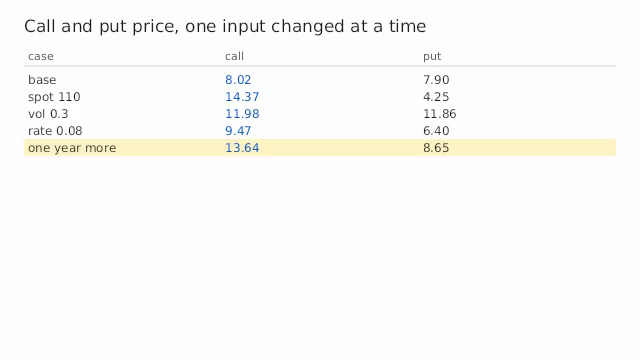
Move the spot from 100 to 110, a move of 10. The run below reprices the call at the spot of 110 and gets 14.37, a change of 6.35 from 8.02. The put falls from 7.90 to 4.25, a change of -3.65.
Run it
The program reprices the call and the put in five situations and puts one row of the ladder for each. The function in lines 1 to 6 prices both options on a model it is given. Line 7 is the base model. Line 13 changes only the spot, line 14 only the volatility (using the model built in line 10), line 15 only the rate, and lines 16 to 18 add one year.
Watch the steps (recorded video)
fn row(label: string, c: Option, p: Option, md: Model) -> string {
  let e = pricing.analytic();
  let a = lmf.money(pricing.price(c, md, e).price());
  let b = lmf.money(pricing.price(p, md, e).price());
  return label + "|" + a + "|" + b;
}
let m = model.black_scholes(spot, rate, 0.0, vol);
let call = instrument.european_call(strike, float(years));
let put = instrument.european_put(strike, float(years));
let m2 = m.with_vol(vol2);
let rows = str_list();
rows.add(row("base", call, put, m));
rows.add(row("spot " + str(spot2), call, put, m.with_spot(spot2)));
rows.add(row("vol " + str(vol2), call, put, m2));
rows.add(row("rate " + str(rate2), call, put, m.with_rate(rate2)));
let call2 = instrument.european_call(strike, float(years + 1));
let put2 = instrument.european_put(strike, float(years + 1));
rows.add(row("one year more", call2, put2, m));
lmcode_return_put("rows", rows);
let high = pricing.price(call, m2, pricing.analytic());
let d1 = pricing.bs_d1(call, m2);
let hand = spot * lmf.norm_pdf(d1) * sqrt(float(years));
lmcode_return_put("vega_gap", lmf.round(high.vega() - hand, 6));
let answer = int(math_round(lmf.round(high.price(), 2) * 100.0));
{
  "answer": 1198,
  "rows": [
    "base|8.02|7.90",
    "spot 110|14.37|4.25",
    "vol 0.3|11.98|11.86",
    "rate 0.08|9.47|6.40",
    "one year more|13.64|8.65"
  ],
  "vega_gap": 0
}
In this run the higher spot raises the call and lowers the put, the higher volatility raises both, the higher rate raises the call and lowers the put, and the extra year raises both for these inputs (with 3 years the extra year lowers the put, 8.82 to 8.75, so read the table after an edit, not this sentence). These are statements about this formula with the other inputs held fixed.
The vega of the engine at the higher volatility and the value from the formula, spot times the normal density at d1 times the square root of the years, differ by 0 at six decimals (lines 21 to 23). Line 24 returns the call price at the higher volatility, in whole cents.
You can change the seven inputs, with a rate2 above -1, and the years, a whole number of 1 or more. A spot or a volatility of 0 stops line 7, and a strike or 0 years stops line 8. A spot2 or a vol2 of 0 stops line 3 inside the function, with "spot must be positive" or "volatility must be positive", and the other messages are the engine's, as in the lessons before.
Your turn
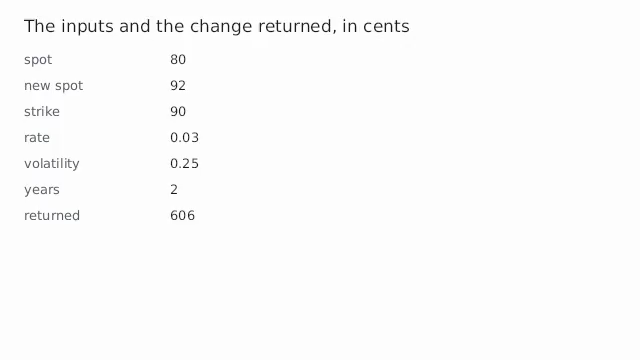
The program below is meant to return the change of the call price, in whole cents, when the spot moves from spot to new_spot, with the strike, the rate, the volatility and the years as they are. The change may be negative. Decide whether it does, and find the candidates that do. Check runs each candidate on the data shown and on four others.
let m = model.black_scholes(spot, rate, 0.0, vol);
let call = instrument.european_call(strike, float(years));
let engine = pricing.analytic();
let before = pricing.price(call, m, engine);
let move = new_spot - spot;
let change = before.delta() * move;
let answer = int(math_round(lmf.round(change, 2) * 100.0));
{
  "answer": 606
}
Return, in whole cents, the change of the Black-Scholes price of the European call (no dividend) when the spot moves from spot to new_spot and the strike, rate, volatility and years stay as they are: the price at the new spot minus the price at the old spot. The change is rounded to cents and may be negative.
Read the result carefully
"Raises" and "lowers" are statements about this formula with the other inputs held fixed. In a market the inputs move together, and the volatility is not observed at all: it is a model input. The page says nothing about which way a real price will move.
Delta and gamma are the first two slopes of the price in the spot; the table shows prices, not slopes. The inputs are made up, and the page describes a model and is not investment advice. For delta and gamma on a tree see Option Greeks.
Recap
- With the others fixed, a higher spot raises the call and lowers the put.
- A higher volatility raises both prices in this example.
- A higher rate raises the call and lowers the put here.
- Delta and gamma are the first two slopes of the price in the spot.