The Put and Put-Call Parity
The put formula mirrors the call's, and the call minus the put equals the spot minus the discounted strike for any volatility; use the relation to turn a call quote into a put price.
The question
The same model prices a European put, the right to sell at the strike. Its formula mirrors the call's. A second fact holds for any volatility: the call minus the put is the spot minus the strike discounted at the rate, with no model of the stock in it. What does that relation say, and what does it let you do with a quote?
The relation is the subject of the lesson put-call-parity of Option Payoffs, which works it out from payoffs. Here the model's prices obey it.
Work it by hand
Take the example of the book: spot 100, strike 105, rate 0.05, volatility 0.2, one year. The call is worth 8.02. The discount factor is e to the power of -0.05, 0.9512, so the strike discounted is 105 times 0.9512 = 99.88.
Parity says call minus put equals spot minus the discounted strike, 100 minus 99.88 = 0.12. So the put is the call minus 0.12: 8.02 minus 0.12 is 7.90. The put is worth 7.90 to the cent and the call 8.02: they differ by 0.12 whatever the volatility.
Run it
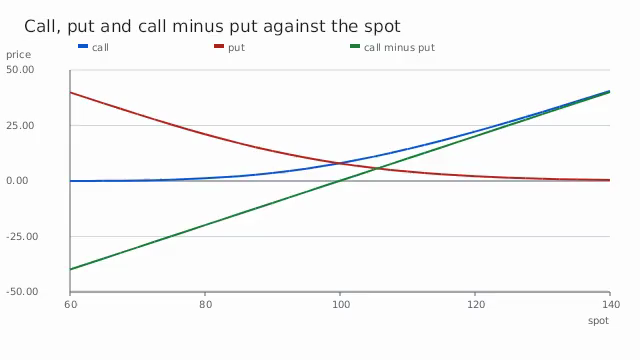
The program prices the call and the put for 33 spots, from 60 to 140 in steps of 2.5, and shows the three curves. Line 4 chooses the closed form. The loop of lines 7 to 13 builds the model at each spot with with_spot in line 8 and prices both options on it. Line 17 returns the put price at the input spot, in whole cents.
let m = model.black_scholes(spot, rate, 0.0, vol);
let call = instrument.european_call(strike, float(years));
let put = instrument.european_put(strike, float(years));
let engine = pricing.analytic();
let xs = float_list(); let calls = float_list();
let puts = float_list(); let diffs = float_list();
for (k in range(0, 33)) {
  let at = m.with_spot(60.0 + 2.5 * float(k));
  let c = pricing.price(call, at, engine).price();
  let p = pricing.price(put, at, engine).price();
  xs.add(60.0 + 2.5 * float(k)); calls.add(lmf.round(c, 4));
  puts.add(lmf.round(p, 4)); diffs.add(lmf.round(c - p, 4));
}
lmcode_return_put("spots", xs); lmcode_return_put("calls", calls);
lmcode_return_put("puts", puts); lmcode_return_put("diffs", diffs);
let own = pricing.price(put, m, engine).price();
let answer = int(math_round(lmf.round(own, 2) * 100.0));
{
  "answer": 790,
  "spots": [
    60,
    62.5,
    65,
    67.5,
    70,
    72.5,
    75,
    77.5,
    80,
    82.5,
    85,
    87.5,
    90,
    92.5,
    95,
    97.5,
    100,
    102.5,
    105,
    107.5,
    110,
    112.5,
    115,
    117.5,
    120,
    122.5,
    125,
    127.5,
    130,
    132.5,
    135,
    137.5,
    140
  ],
  "calls": [
    0.0266,
    0.0506,
    0.0909,
    0.1548,
    0.2517,
    0.3924,
    0.5887,
    0.8535,
    1.1995,
    1.6391,
    2.1833,
    2.8415,
    3.6213,
    4.5277,
    5.5633,
    6.7285,
    8.0214,
    9.4381,
    10.9731,
    12.6198,
    14.3703,
    16.2165,
    18.1498,
    20.1614,
    22.2431,
    24.3867,
    26.5847,
    28.83,
    31.1162,
    33.4376,
    35.789,
    38.1658,
    40.5641
  ],
  "puts": [
    39.9057,
    37.4297,
    34.97,
    32.5339,
    30.1308,
    27.7715,
    25.4678,
    23.2326,
    21.0786,
    19.0182,
    17.0624,
    15.2206,
    13.5004,
    11.9068,
    10.4424,
    9.1076,
    7.9004,
    6.8171,
    5.8522,
    4.9989,
    4.2494,
    3.5956,
    3.0289,
    2.5405,
    2.1222,
    1.7658,
    1.4638,
    1.2091,
    0.9953,
    0.8167,
    0.6681,
    0.5449,
    0.4432
  ],
  "diffs": [
    -39.8791,
    -37.3791,
    -34.8791,
    -32.3791,
    -29.8791,
    -27.3791,
    -24.8791,
    -22.3791,
    -19.8791,
    -17.3791,
    -14.8791,
    -12.3791,
    -9.8791,
    -7.3791,
    -4.8791,
    -2.3791,
    0.1209,
    2.6209,
    5.1209,
    7.6209,
    10.1209,
    12.6209,
    15.1209,
    17.6209,
    20.1209,
    22.6209,
    25.1209,
    27.6209,
    30.1209,
    32.6209,
    35.1209,
    37.6209,
    40.1209
  ]
}
The call rises and the put falls as the spot rises, and their difference, the third line, is straight with slope 1. You can change the strike, the rate, the volatility and the years, a whole number of 1 or more. A spot of 0 stops line 1 with "model.black_scholes: spot must be positive", a volatility of 0 stops it with "volatility must be positive", and a strike of 0 stops line 2 with "option strike must be positive".
Your turn
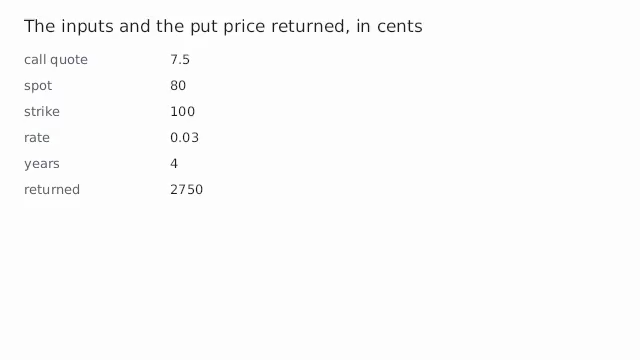
A call is quoted at quote, a made-up number that is not this model's price. The program below is meant to return, in whole cents, the put price that parity implies for the same strike and years, from the quote, the spot, the strike and the rate: no volatility is involved. Decide whether it does, and find the candidates that do. Check runs each candidate on the data shown and on four others.
let curve = market.flat_curve_compounded(rate, "continuous");
let factor = curve.discount(float(years));
let put = quote - spot + strike;
let answer = int(math_round(lmf.round(put, 2) * 100.0));
{
  "answer": 2750
}
A European call is quoted at quote, a made-up number. Return, in whole cents, the price of the European put with the same strike and years that put-call parity implies, with no dividend and money lent and borrowed at the continuously compounded rate. The price is rounded to cents.
Read the result carefully
Parity needs no model of the stock, only that both options are European, that no dividend is paid before expiry and that money can be lent and borrowed at one rate. The put formula, by contrast, does need the model. The discount factor comes from a curve built with continuous compounding, market.flat_curve_compounded(rate, "continuous"): the older market.flat_curve counts calendar days.
The quote and the inputs are made up, and parity says nothing about whether any quote is fair. The page describes a model and is not investment advice.
Recap
- Call minus put equals spot minus the strike discounted at the rate.
- It holds for every volatility, so a call quote gives a put price.
- The put formula mirrors the call's and needs the model; parity does not.
- Parity ties together the call, the put, the spot and the discounted strike.