Scale the Train Rows
Transform training features onto [0, 1] by subtracting tr_min and dividing by tr_span = tr_max - tr_min while keeping held-out rows masked.
The problem
In Fit Min and Max on Train, we locked in tr_min, tr_max, and tr_span = tr_max - tr_min from role == 1 rows alone. Now we use that ruler to place every training row onto the unit interval [0, 1] before fitting weights.
Two arithmetic pieces must happen in order: shift the lowest training point down to 0 by subtracting tr_min, then divide that distance by tr_span—not by tr_max—so the highest training point lands squarely on 1.
Work through the numbers
Take five [role, x] rows in table = [[1, 10], [1, 15], [0, 50], [1, 25], [1, 30]]. Training rows (role = 1) take values [10, 15, 25, 30], so tr_min = 10, tr_max = 30, and tr_span = 30 - 10 = 20. Held-out row r2 = 50 (role = 0) stays masked at 0 until the test transform step.
Evaluating (x - 10) / 20 across the four training rows places each one at its exact fractional position inside [10, 30]:
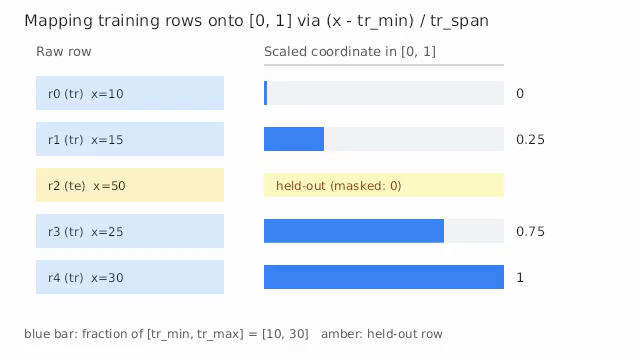
r0(x = 10):(10 - 10) / 20 = 0 / 20 = 0r1(x = 15):(15 - 10) / 20 = 5 / 20 = 0.25r2(role = 0,x = 50): masked bytr_mask = 0->0r3(x = 25):(25 - 10) / 20 = 15 / 20 = 0.75r4(x = 30):(30 - 10) / 20 = 20 / 20 = 1
That produces scaled_train = [0, 0.25, 0, 0.75, 1]. Notice why dividing by tr_max = 30 fails whenever tr_min > 0: (30 - 10) / 30 = 20 / 30 = 0.6667, stopping short of 1.
The live model
Blue bars fill the [0, 1] track for every role == 1 row while r2 remains masked in amber. At default r1_x = 15, r1 fills one quarter of the track (0.25). Slide r1_x down to 10 to touch 0, across 20 (0.5) and 25 (0.75), and up to 30 to hit 1, watching r1 sweep smoothly across [0, 1] without changing tr_min = 10 or tr_span = 20.
let r1_x = scene.parameter("r1_x", 15.0, 10.0, 30.0, 5.0);
let table = input.clone();
table.select(0, 1).set(1, r1_x);
let role = table.select(1, 0);
let x = table.select(1, 1);
let hi = x * 0.0 + x.max() + 1.0;
let lo = x * 0.0 + x.min() - 1.0;
let is_tr = role.eq(1.0);
let tr_mask = is_tr.to(DType.F64);
let tr_min = torch.where(is_tr, x, hi).min();
let tr_max = torch.where(is_tr, x, lo).max();
let tr_span = tr_max - tr_min;
let answer = (x - tr_min).div(tr_span) * tr_mask;
out.set("tr_min", tr_min).set("tr_span", tr_span).set("scaled_train", answer);
{
  "tr_min": 10,
  "tr_span": 20,
  "scaled_train": [
    0,
    0.25,
    0,
    0.75,
    1
  ]
}
Your turn
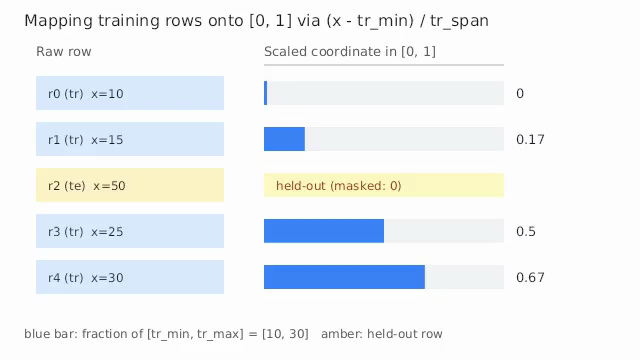
Observe row r4 (x = 30, the highest training reading) in the starter diagram: its bar stops two-thirds of the way across the unit track at 0.67, and r1 sits at 0.17 instead of 0.25. Fix the scaling denominator so the training rows stretch cleanly from 0 at r0 to 1 at r4 while r2 stays masked at 0. Check grades on a four-row table and a five-row table.
let table = input;
let role = table.select(1, 0);
let x = table.select(1, 1);
let hi = x * 0.0 + x.max() + 1.0;
let lo = x * 0.0 + x.min() - 1.0;
let is_tr = role.eq(1.0);
let tr_mask = is_tr.to(DType.F64);
let tr_min = torch.where(is_tr, x, hi).min();
let tr_max = torch.where(is_tr, x, lo).max();
let answer = (x - tr_min).div(tr_max) * tr_mask;
out.set("scaled_train", answer);
{
  "scaled_train": [
    0,
    0.16666666666666666,
    0,
    0.5,
    0.6666666666666666
  ]
}
Rescale the training rows onto the unit interval [0, 1] in answer while keeping held-out slots masked at 0.
Using the training interval width stretches the bars to [0, 0.25, 0, 0.75, 1], placing r0 on 0 and r4 squarely on 1.
Read the result carefully
Both endpoints are guaranteed on every training set with tr_max > tr_min: (tr_min - tr_min) / tr_span = 0 at the bottom of the training range and (tr_max - tr_min) / tr_span = 1 at the top, regardless of where tr_min sits relative to zero.
Recap
- Min-max scaling maps training rows via
(x - tr_min) / (tr_max - tr_min), placingtr_minat0andtr_maxat1. - Dividing by
tr_max(30) instead oftr_span(20) compresses the upper training endpoint to(tr_max - tr_min) / tr_maxwhenevertr_min != 0. - Held-out rows (
r2 = 50) play zero part in fitting[tr_min, tr_max]or scaling the training matrix.