CertificateVerify Signs the Transcript
The server signs 64 bytes of 0x20, a context string, a zero byte and the transcript hash through the Certificate message; the recording's signature verifies under its test leaf key.
The question
The server sends its certificate, and anyone can copy a certificate. How does the server show that it holds the private key that belongs to it?
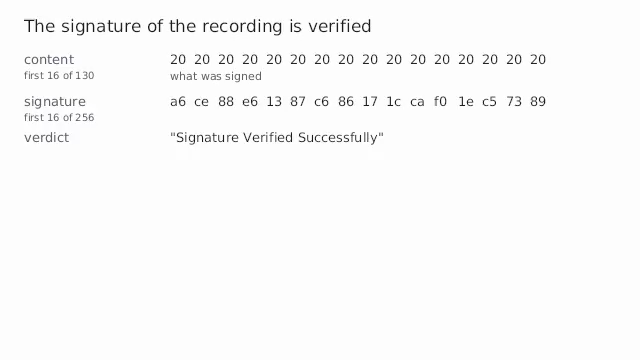
It signs. The signature in the CertificateVerify message covers a fixed content: 64 bytes of 0x20, a context string, a zero byte and the hash of the handshake so far (RFC 9846, 4.5.2). This page verifies the signature of the recorded loopback connection, a connection between two test programs made on 2026-11-20 and kept as test material, with the public key of its test certificate. How is the content built, and which hash goes in?
Work it by hand
The context string for a server is TLS 1.3, server CertificateVerify: 33 characters. The content is 64 bytes of 20, those 33 bytes, one 00 byte and a 32-byte hash: 64 + 33 + 1 + 32 = 130 bytes. For a client the string is TLS 1.3, client CertificateVerify.
The hash is the hash of the messages up to and including the Certificate message, and not the hash that includes CertificateVerify itself, because the signature is part of that message. The CertificateVerify message of the recording is 0f 000104 (type 15, length 260), then the algorithm 0804 (rsa_pss_rsae_sha256) and the 2-byte signature length 0100, 256, followed by the 256 signature bytes.
Run it
The command verifies a signature with a public key. -rawin hands it the 130 bytes of content itself, the digest is SHA-256, and the padding mode is PSS with a salt as long as the digest. The inputs are the public key of the test leaf certificate (test material, in pub), the content (content) and the signature (sig) taken from the recording.
Public test material, generated for this lesson. Never use it for anything real.
# Verify the CertificateVerify signature of the recording.
# in/content.bin is what was signed, in/sig.bin the 256 signature bytes.
# in/pub.txt is the public key of the test leaf certificate (test material).
pkeyutl -verify -pubin -inkey in/pub.txt -rawin -in in/content.bin \
  -sigfile in/sig.bin -pkeyopt rsa_padding_mode:pss \
  -pkeyopt rsa_pss_saltlen:digest -digest sha256
{
  "answer": "Signature Verified Successfully"
}
The command prints Signature Verified Successfully and exits with status 0. Change one byte of the content or of the signature and the command exits with status 1 after printing Signature Verification Failure; the page shows only the last line of OpenSSL's error list, OpenSSL: RSA lib, and the first line of that list says bad signature. The same happens with the hash that includes CertificateVerify itself in place of the one before it.
Your turn
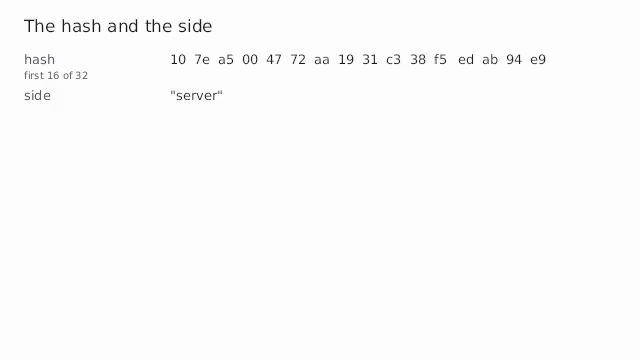
A server author wants the content that is to be signed. The program below is meant to return it as hex for a transcript hash (32 bytes, hash) and a side, server or client: the bytes of the content in order, as the page showed it. Decide whether it does, and find the candidates that do. Check runs each candidate on the data shown and on four others.
The hashes are hashes of the recording, except in one case that uses the example of RFC 9846, 4.5.2 (32 bytes of 01); the data are test material.
Public test material, generated for this lesson. Never use it for anything real.
let context = "TLS 1.3, " + side + " CertificateVerify";
let pad = str_repeat("20", 64);
let answer = pad + ssl.hex(context) + hash;
{
  "answer": "20202020202020202020202020202020202020202020202020202020202020202020202020202020202020202020202020202020202020202020202020202020544c5320312e332c20736572766572204365727469666963617465566572696679107ea5004772aa1931c338f5edab94e96ceb32d29c1dbfab57cb10fcbb25621a"
}
Return the content covered by a CertificateVerify signature as hex (RFC 9846, 4.5.2): the 64 bytes of 0x20, the context string for the side (server or client), the separator byte and the transcript hash given in hash.
Read the result carefully
A verified signature shows that whoever made it held the private key of that test certificate and signed this content. It does not show that the certificate is trusted: that is the chain check of A Certificate Chain Trusts a Root, and the host name is a separate check. The Certificate message of the recording carries two certificates, the leaf and the intermediate, and not the root (stated here from the recording's file, not run).
The page verifies one signature from one recording. It does not show how a server signs, what a client certificate looks like, timing, or what an attacker could do.
What is inside a certificate is read field by field in A Certificate, Field by Field, and how a small test chain is made and checked in A Small Certificate Authority; both use other test certificates than this recording.
To run a fresh TLS 1.3 handshake with your own client and server in the tab, start with A TLS 1.3 Handshake You Can Step Through; to trigger failures, see TLS Failures You Can Trigger.
Recap
- The signed content is 64 bytes of 0x20, a context string, a zero byte and a transcript hash.
- The server and client strings differ, so a signature made for one cannot be reused for the other.
- The hash covers the messages up to the Certificate message, not CertificateVerify.
- A good signature proves possession of the key, not that the certificate is trusted.