Same Scored Rows
Inspect nine scored rows and separate the fixed recall denominator from the moving precision denominator across cutoffs.
The problem
Precision and recall look similar at a glance because both put true positives (TP) in the numerator. Confusion starts in the denominator: recall divides TP by actual positives (TP + FN), a property of the dataset, whereas precision divides TP by predicted positives (TP + FP), a property of the chosen cutoff.
Across this book we hold one nine-row table fixed: [0.95, 1], [0.90, 1], [0.75, 1], [0.70, 0], [0.60, 0], [0.40, 1], [0.30, 0], [0.15, 0], and [0.10, 0]. Measuring cutoffs in sixths (threshold = sixths / 6.0 for sixths = 1..5) lets us compare 3 / 6 = 1 / 2 and 5 / 6 exactly while returning [actual_pos, pred_pos, tp].
Work through the numbers
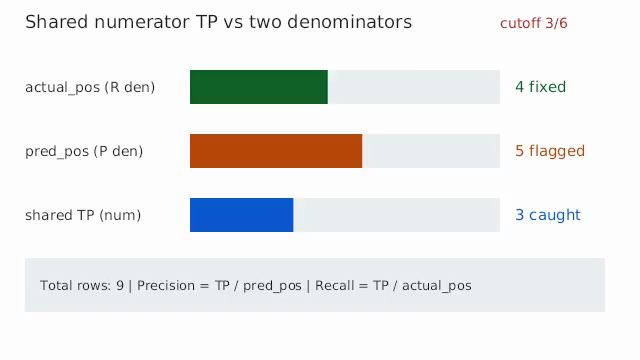
First count actual labels across all nine rows: rows 0, 1, 2, 5 (0.95, 0.90, 0.75, 0.40) carry y = 1, giving actual_pos = 4, while rows 3, 4, 6, 7, 8 carry y = 0 (5 negatives). That 4 never changes when the cutoff moves.
Now trace pred_pos (prob > sixths / 6) and tp across sixths:
- At
sixths = 3(threshold = 3 / 6 = 0.50): five rows (0.95, 0.90, 0.75, 0.70, 0.60) clear0.50, sopred_pos = 5and three of them are truly positive (tp = 3), yielding[4, 5, 3]. - At
sixths = 4(threshold = 4 / 6 ≈ 0.67): row4(0.60,y = 0) drops out, shrinkingpred_posto4whiletpstays3([4, 4, 3]). - At
sixths = 5(threshold = 5 / 6 ≈ 0.83): only0.95and0.90clear5 / 6, shrinkingpred_posto2andtpto2([4, 2, 2]).
Lowering sixths to 2 (2 / 6 ≈ 0.33) flags six rows and catches all four positives ([4, 6, 4]).
The live model
Three horizontal bars compare actual_pos (recall's denominator), pred_pos (precision's denominator), and tp (their shared numerator) out of 9 rows. Slide sixths from 1 to 5: the top green actual_pos bar stays locked at 4 at every stop, while pred_pos contracts from 7 down to 2 and tp steps from 4 down to 2.
let sixths = scene.parameter("sixths", 3.0, 1.0, 5.0, 1.0);
let cutoff = sixths / 6.0;
let prob = input.select(1, 0);
let label = input.select(1, 1);
let pred = prob.gt(cutoff).to(DType.F64);
let actual_pos = label.sum();
let pred_pos = pred.sum();
let tp = (pred * label).sum();
let parts = torch.list().add(actual_pos.reshape(1)).add(pred_pos.reshape(1));
let answer = torch.cat(parts.add(tp.reshape(1)), 0);
out.set("cutoff", cutoff).set("denominators_and_tp", answer);
{
  "cutoff": 0.5,
  "denominators_and_tp": [
    4,
    5,
    3
  ]
}
Watch the parameter change
Your turn
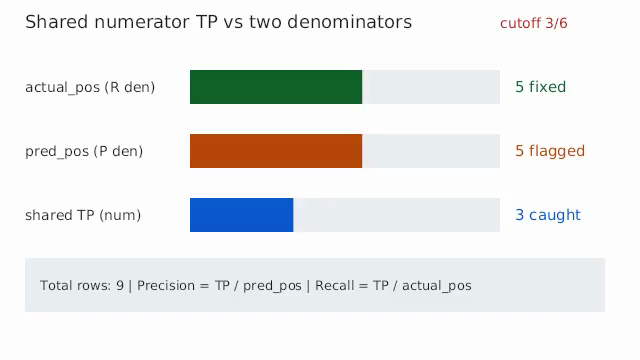
Compute [actual_pos, pred_pos, tp] under prob > sixths / 6.0. The starter uses pred_pos for both denominators, erasing the distinction between actual positives and predicted positives whenever FP != FN. Check tests unseen tables and multiple sixths cutoffs.
let sixths = scene.parameter("sixths", 3.0, 1.0, 5.0, 1.0);
let cutoff = sixths / 6.0;
let prob = input.select(1, 0);
let label = input.select(1, 1);
let pred = prob.gt(cutoff).to(DType.F64);
let actual_pos = pred.sum();
let pred_pos = pred.sum();
let tp = (pred * label).sum();
let parts = torch.list().add(actual_pos.reshape(1)).add(pred_pos.reshape(1));
let answer = torch.cat(parts.add(tp.reshape(1)), 0);
out.set("cutoff", cutoff).set("denominators_and_tp", answer);
{
  "cutoff": 0.5,
  "denominators_and_tp": [
    5,
    5,
    3
  ]
}
Compute [actual_pos, pred_pos, tp] under rule prob > sixths / 6.0 on any scored table.
Read the result carefully
Every precision-recall curve on a held-out set comes from this exact contrast on one fixed score column: recall's denominator (actual_pos = 4) is anchored before any model runs, so recall moves strictly in lockstep with tp, whereas precision's denominator (pred_pos) shrinks alongside tp as sixths rises, allowing tp / pred_pos to climb even while tp falls.
Recap
- Our nine-row table contains
4actual positives (0.95, 0.90, 0.75, 0.40) and5actual negatives. - At
sixths = 3(1 / 2),[actual_pos, pred_pos, tp] = [4, 5, 3]; atsixths = 5(5 / 6), it becomes[4, 2, 2]. - Recall's denominator (
actual_pos) is invariant to the cutoff, while precision's denominator (pred_pos) changes whenever a row crosses the cutoff.