What a Fit Does Not Say
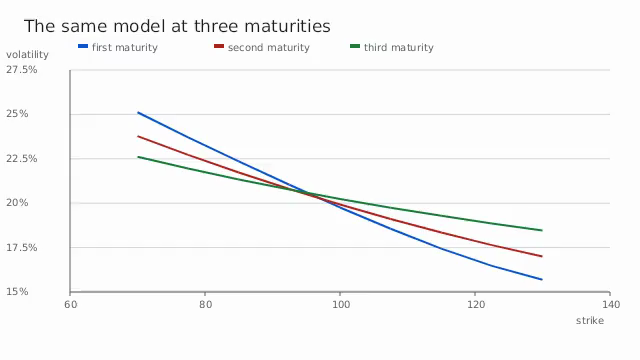
The same Heston parameters give a different smile at each maturity (the first-to-last gap is 943 basis points at one year, 677 at two and 415 at four), and a fit to some quotes is a description of those quotes, not knowledge about other products or the future.
The question
A model has been fitted to quotes at one maturity. What else does the fit say? In particular, what does the same model say about other maturities, and about other options?
This lesson looks at the maturities and at the limits of the engine, and the honest answer is that a fit says little beyond the quotes it was made to match. The parameters are the fixed example of the book: v0 = 0.04, kappa = 1.5, theta = 0.04, sigma = 0.3 and a rho of −0.7, with spot 100 and a rate of 5%; they are made-up inputs. It is a description of an arithmetic model and not investment advice.
Work it by hand
The smile of the model at one year is steep. Over a longer time the variance has more time to be pulled back to theta, so the options see more of the long-run level and less of the starting variance and the shocks of the variance. The smile should flatten as the maturity grows, and the expected variance tends to theta, whose square root is 20% in the example; the implied volatility is a different quantity and need not reach it.
The page measures the slope as the gap between the volatility at the lowest strike and at the highest strike, in basis points. The recorded run in Run it gives three gaps, and they shrink as expected.
Run it
The program takes the strikes, a list of three maturities in years, the spot, the rate and the parameters; the correlation is fixed at −0.7. Line 1 builds the Heston model. The loop from line 3 asks the engine, calibration.smile, at line 4 for the implied volatility at every strike for each maturity and sorts the values into three lists.
Line 15 returns the square root of theta in whole basis points, 20%, the volatility that the model's variance is pulled towards; the smiles of the picture lie around it but are not required to meet it.
let h = model.heston(spot, rate, 0.0, v0, kappa, theta, sigma, 0.0 - 0.7);
let a = float_list(); let b = float_list(); let c = float_list();
for (j in range(0, 3)) {
  let s = calibration.smile(h, strikes, maturities.at(j));
  for (i in range(0, strikes.len())) {
    let v = lmf.round(s.at(i), 4);
    if (j == 0) { a.add(v); }
    if (j == 1) { b.add(v); }
    if (j == 2) { c.add(v); }
  }
}
lmcode_return_put("short", a);
lmcode_return_put("middle", b);
lmcode_return_put("long", c);
let answer = int(math_round(lmf.round(sqrt(theta), 4) * 10000.0));
{
  "answer": 2000,
  "short": [
    0.2512,
    0.2371,
    0.2235,
    0.2104,
    0.1976,
    0.1856,
    0.1744,
    0.1647,
    0.1569
  ],
  "middle": [
    0.2378,
    0.2272,
    0.2173,
    0.208,
    0.1993,
    0.1911,
    0.1835,
    0.1764,
    0.17
  ],
  "long": [
    0.2261,
    0.2195,
    0.2134,
    0.2077,
    0.2024,
    0.1975,
    0.1929,
    0.1886,
    0.1846
  ]
}
In the recorded run the gap between the first and the last strike is 943 basis points at one year (25.12% to 15.69%), 677 at two years (23.78% to 17.00%) and 415 at four years (22.61% to 18.46%); the gaps are taken from the unrounded volatilities, so 23.78 − 17.00 = 6.78 differs from 6.77 by the rounding of the two shown values.
You can change every number except the correlation, which is written into line 1. Each maturity must be above 0 and at most 100 years (fractions are accepted): a maturity of 0 stops at line 4 with "calibration.smile: years must be above 0 and at most 100, got 0", and a list of two maturities stops there with "FloatList.at: index out of range: 2".
v0, kappa, theta and sigma must be positive and the spot too, or the run stops at line 1; each strike must be positive and not far above the spot (500 stops at line 4 with "calibration.smile: no implied volatility at strike 500 (price -3.76505e-15 is outside the range reachable with volatility in [0.0001, 5])"). At 50 or 100 years the strikes of the picture are far below the forward price and every smile lies between 20.75% and 21.15%.
Your turn
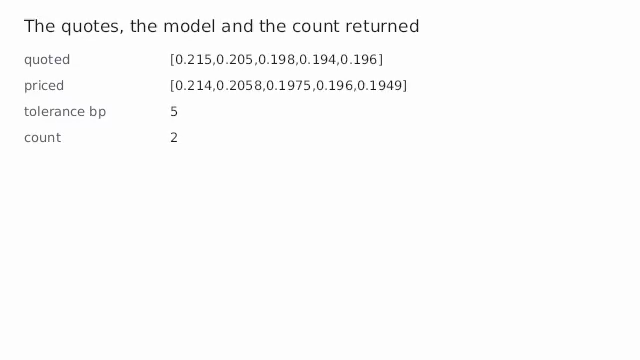
A desk compares a model with the quotes it was fitted to. The lists quoted and priced hold implied volatilities per quote, in the same order, and tol is a tolerance in basis points. The program below is meant to return how many quotes the model misses by more than tol basis points, in either direction. Decide whether it does, and find the candidates that do. Check runs each candidate on the lists shown and on five others.
let count = 0;
for (i in range(0, quoted.len())) {
  let gap = lmf.round((priced.at(i) - quoted.at(i)) * 10000.0, 4);
  if (gap > tol) { count = count + 1; }
}
let answer = count;
{
  "answer": 2
}
The lists quoted and priced hold implied volatilities per quote, in the same order, and tol is a tolerance in basis points. Return how many quotes the model misses by more than tol basis points, whether the model is above or below the quote. A miss of exactly tol is not more than tol.
Read the result carefully
A model with more parameters can fit more quotes, and that is not the same as being right. The Heston example has five parameters; it has constant parameters, a constant rate and no jumps, and the fit can be weakly determined: different parameter sets can give nearly the same smile at one maturity and differ at another.
A fitted smile describes the quotes that were used. It is no knowledge about the future or about other products, and the engine reflects this as a limit: it prices only European options with a Heston model. An American put on a Heston model stops with "the Heston analytic engine prices European options only". No page of this book says what an option should cost. It is a description of an arithmetic model and not investment advice.
Recap
- The same parameters give a different smile at each maturity; in the example the smile flattens as the maturity grows.
- A fit to some quotes is a description of those quotes, not knowledge of anything else.
- More parameters fit more quotes, which is not the same as being right.
- The engine prices only European options with the Heston model.