ECDSA Signatures Are Random
An ECDSA signature uses a fresh random number for every signature, so signing one message twice gives two different signatures, both of which verify; the page checks signatures of a fixed test key and never returns a fresh one.
The question
Sign the same message twice with the same RSA key and PKCS#1 v1.5, and you get the same bytes. Do the same with ECDSA, and you do not. Is something wrong? No: an ECDSA signature includes a fresh random number, and a new one is drawn every time. So a signature cannot be compared byte by byte with another; the only test is to verify it.
The key p256-signer is test material, a P-256 key made for these lessons. The signatures the page checks were made once with it and are fixed; the page never signs a case itself, because every new signature would differ.
Work it by hand
FIPS 186-5 section 6.4.1 describes the signing steps. With the private number d, the order n of the curve and e the integer made from the message's hash, the signer
- generates a per-message secret number k, using a procedure of section 6.3;
- computes the point k times G, and sets r to the x-coordinate of that point modulo n;
- computes s as the inverse of k modulo n, times e plus r times d, modulo n.
The standard says that a value k shall be generated at each invocation of the signature generation algorithm. A different k gives a different point, so a different r, and a different s. The pair (r, s) is sent as the ASN.1 structure of RFC 3279 section 2.2.3, a sequence of two INTEGER values.
The length of the structure varies. Each of r and s is a 32-byte number, and an INTEGER whose first bit is set gets an extra leading zero byte, so each takes 32 or 33 bytes. With the two headers of 2 bytes each and the sequence header of 2 bytes, the whole signature is 70, 71 or 72 bytes (shorter only when r or s has a leading zero byte, which is rare).
One run of 30 signatures of the message meet at noon with the test key gave 7 of 70 bytes, 14 of 71 and 9 of 72 (stated here, not run on this page; another run gives other counts).
Run it
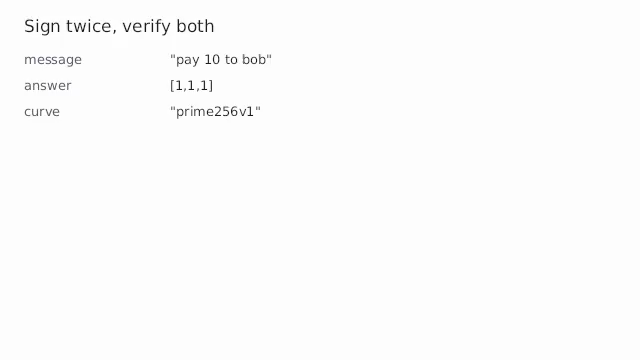
The program makes a fresh P-256 key with ssl.gen_ec, signs the message twice with SHA-256 and returns three yes-or-no values as 1 or 0. Lines 2 and 3 sign; line 6 asks whether the two signatures differ, and lines 8 and 10 verify each of them with the key.
The answer is 1, 1, 1: the signatures differ, and both verify. The signatures themselves are not returned: they change on every run, and so does their length.
Public test material, generated for this lesson. Never use it for anything real.
let k = ssl.gen_ec("P-256");
let first = k.sign("SHA256", message);
let second = k.sign("SHA256", message);
let answer = int_list();
answer.add(0);
if (first != second) { answer.set(0, 1); }
answer.add(0);
if (k.verify("SHA256", message, first)) { answer.set(1, 1); }
answer.add(0);
if (k.verify("SHA256", message, second)) { answer.set(2, 1); }
lmcode_return_put("curve", k.curve());
{
  "answer": [
    1,
    1,
    1
  ],
  "curve": "prime256v1"
}
You can change the message to any text. An empty message works. The answer stays 1, 1, 1 on every run, because the chance that two random numbers coincide is far too small to meet; the page does not compute it.
Your turn
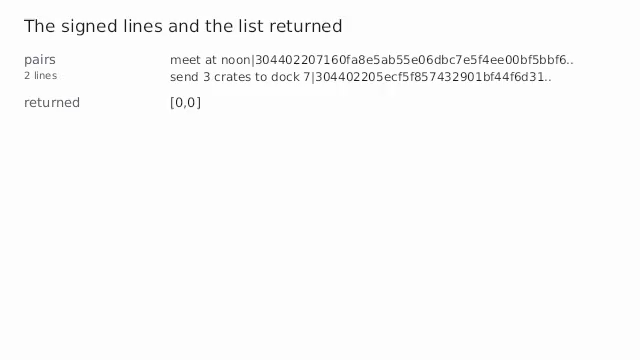
The program below should check signatures made by the key in key: pairs holds one line for each pair, a message, a bar and the signature as hexadecimal DER, and the program returns a list with one number per line, 1 if the signature is a valid ECDSA signature of that message with SHA-256 and 0 if not. Decide whether it does, and find the candidates that do. Check runs each candidate on the data shown and on five others.
Public test material, generated for this lesson. Never use it for anything real.
let k = ssl.parse_key(key);
let lines = str_split(pairs, "\n");
let answer = int_list();
for (i in range(0, lines.len())) {
  let parts = str_split(lines.at(i), "|");
  let valid = k.verify("SHA1", parts.at(0), parts.at(1));
  answer.add(0);
  if (valid) { answer.set(i, 1); }
}
{
  "answer": [
    0,
    0
  ]
}
key is the text of a P-256 private key; pairs is text with one line per pair, message, a bar, the DER signature in hexadecimal; the signatures were made with ECDSA and SHA-256. Return a list with one whole number per line: 1 if the signature is a valid signature of that line's message under that key, 0 if not. A message contains no bar.
Read the result carefully
A valid signature shows that someone holding the private key signed exactly this message. Because signatures are random, the same message can have many valid signatures, and a program must never decide validity by comparing a new signature with an old one. It must verify.
The key and the signatures of the cases are test material, made once and kept; the page shows no key generation for them and no timing. It does not show how the random number is chosen, which is the subject of the lesson on a repeated number, nor the variant in which k is derived from the message instead of drawn at random, nor how the curve is chosen.
Recap
- ECDSA draws a fresh random number k for every signature, so two signatures of one message differ.
- Every one of them verifies; verification is the only test.
- The signature is two INTEGERs in a sequence, usually 70 to 72 bytes on P-256.
- A program must not return or compare a freshly made signature.