What a Valid Signature Does Not Say
A valid RRSIG shows only that the DNSKEY's holder signed the RRset in its window; the DS chain, missing names and the truth of the data are other questions, and the four states of RFC 4033 name them.
The question
The earlier lessons checked one piece each: a key tag, a DS digest, an RRSIG's fields and one signature. If every piece checks out, what has been shown, and what has not?
The numbers come from the published test material of RFC 8080, section 6.1, which protects nothing. The first key is the one the DS in the first record names; the second key is the other published key of that section. A chain of links is built from the pieces of this book: the DS matches the DNSKEY (lesson 2), the DNSKEY's key tag matches the RRSIG (lessons 1 and 3), and the DNSKEY verifies the RRSIG over the signed data (lessons 4 and 5).
Work it by hand
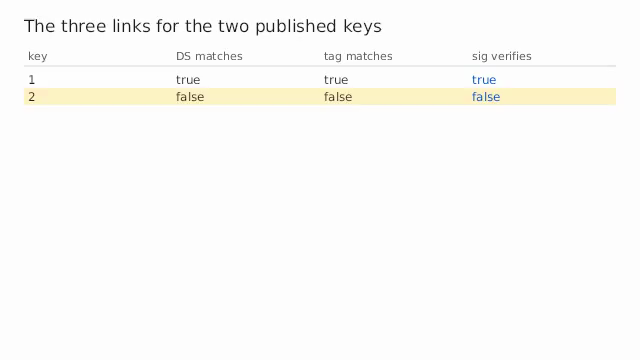
For the first key all three links hold, since the DS, the RRSIG and the signed data belong to it. For the second key none holds: its digest is not the DS digest (the DS names the first key), its key tag is 35217 and the RRSIG names 3613, and its signature check fails because it did not sign that data.
A valid signature says that the holder of the DNSKEY's private key signed this RRset in this time window. It does not say that the DNSKEY is the right one for the zone: that is the DS chain from a trust anchor. It does not say that a name that did not answer does not exist (the NSEC records for that are not shown here), and it does not say that the signed data is true.
Run it
The program takes the owner name (owner), the DNSKEY RDATA of both keys (rdata_a, rdata_b), the digest of the DS (ds), the RRSIG (rrsig), the signed data (data) and the two published private keys (key_a, key_b, test material; the page's Key.verify needs a private key object, a real validator has only the public key). The function of lines 1 to 8 computes the key tag; the signature is taken from the end of the RRSIG at line 11.
The loop from line 13 to the line before the answer checks both keys: line 14 computes the DS digest, lines 15 and 16 verify the signature, and line 18 adds a row. Line 20 returns the rows.
Watch the steps (recorded video)
Public test material, generated for this lesson. Never use it for anything real.
fn tag(r: string) -> int {
  let total = 0;
  for (i in range(0, hex_len(r))) {
    if (i % 2 == 0) { total = total + hex_u8(r, i) * 256; }
    else { total = total + hex_u8(r, i); }
  }
  return (total + total / 65536) % 65536;
}
let rdatas = str_list(); rdatas.add(rdata_a); rdatas.add(rdata_b);
let pems = str_list(); pems.add(key_a); pems.add(key_b);
let sig = hex_slice(rrsig, 31, hex_len(rrsig) - 31);
let rows = str_list();
for (k in range(0, 2)) {
  let dg = ssl.digest("SHA256", ssl.unhex(owner + rdatas.at(k)));
  let pk = ssl.parse_key(pems.at(k));
  let ok = pk.verify("SHA256", ssl.unhex(data), sig);
  let same = tag(rdatas.at(k)) == hex_u16(rrsig, 16);
  rows.add(str(k + 1) + "|" + str(dg == ds) + "|" + str(same) + "|" + str(ok));
}
let answer = rows;
{
  "answer": [
    "1|true|true|true",
    "2|false|false|false"
  ]
}
You can change the inputs freely if the RRSIG has a signer name of 13 bytes (two labels of 7 and 3 letters), because the signature is cut off at byte 31 and the key tag is read at byte 16: another length of name moves the signature. A text that is not a private key stops the run with the message that begins "Ssl.parse_key: cannot read private key".
Your turn
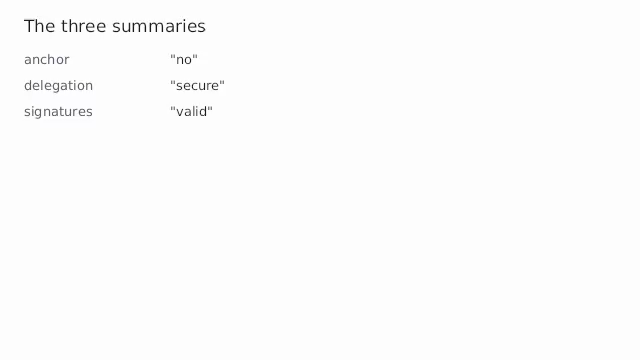
The four security states of RFC 4033, section 5, name what a validating resolver can tell about data: secure, insecure, bogus and indeterminate. The program below models them from three summaries of checks like the ones above: anchor is yes or no (the resolver has a trust anchor), delegation is secure or no-ds-proved (the chain is secure, or at some delegation point a signed proof shows that no DS exists) and signatures is valid or invalid. It is meant to return the state.
Decide whether it does, and find the candidates that do. Check runs each candidate on the case shown and on six others. It models the four names and not the behaviour of a resolver.
Public test material, generated for this lesson. Never use it for anything real.
let answer = "secure";
if (signatures != "valid") { answer = "bogus"; }
if (delegation != "secure") { answer = "insecure"; }
if (anchor != "yes") { answer = "insecure"; }
{
  "answer": "insecure"
}
Return secure, insecure, bogus or indeterminate for the three summaries (RFC 4033, section 5). Without a trust anchor the state is indeterminate. With an anchor and a proof that no DS exists at some delegation point it is insecure. With an anchor and a secure delegation it is secure when the signatures are valid and bogus when they are not.
Read the result carefully
The page does not show how a validator finds the DS and DNSKEY records, how the chain starts from a trust anchor, how NSEC and NSEC3 records prove that a name does not exist, key rollover, wildcard answers or which algorithms a validator supports. The three inputs of the exercise summarise checks that the earlier lessons did one by one.
The model follows RFC 4033, section 5, where indeterminate means that there is no trust anchor. RFC 4035, section 4.3, words indeterminate differently: the resolver cannot obtain the DNSSEC records it needs. The two texts of the RFC set do not say the same.
DNSSEC protects the data in an answer and not the privacy of the question: DNSSEC is not designed to provide confidentiality (RFC 4033, section 4). A signature's validity period is not the TTL: TTL values cannot extend the validity period of signed RRsets (RFC 4033, section 8.1). A key tag does not identify a key: two different DNSKEYs can have the same tag (RFC 4034, section 8).
Recap
- A valid RRSIG shows that the holder of the DNSKEY's private key signed the RRset in its time window.
- It does not show that the DNSKEY is the zone's key, that a missing name does not exist, or that the data is correct.
- The four states are secure, insecure, bogus and indeterminate; they depend on the trust anchor and the chain as well as on the signatures.
- DNSSEC does not hide the question, and a key tag is not an identifier.