Caplet Minus Floorlet Is a Forward
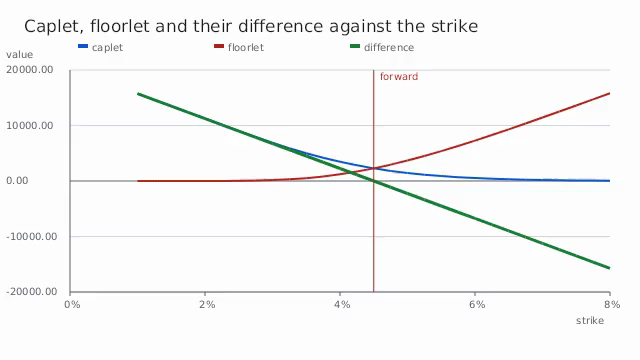
Black's price of a caplet minus Black's price of a floorlet with the same strike is the discounted forward rate minus the strike, whatever the volatility; the program draws both prices and their difference against the strike.
The question
A caplet pays when the rate is above the strike and a floorlet when it is below. Hold the caplet and write the floorlet, with the same strike, the same period and the same payment date. What does the combination pay? If the rate ends above the strike, the caplet pays the difference and the floorlet pays nothing. If it ends below, the caplet pays nothing and the floorlet costs the writer the shortfall, so the combination pays the difference, which is negative.
In both cases it pays the rate minus the strike.
That is what a forward agreement pays: receive the rate, pay the strike. So the two options together are worth what that agreement is worth today, and it does not matter what volatility the model uses. This is the put-call parity of the option book, for a rate.
Work it by hand
With forward rate 4.5%, strike 4%, discount factor 0.9, notional 1,000,000 and accrual 0.5, the combination pays the rate minus the strike on notional times accrual. The expected rate is the forward, so its value today is the notional times the accrual times the discount factor times the forward minus the strike.
- Notional times accrual: 500,000.
- Forward minus strike: 0.005.
- Times the discount factor: 500,000 times 0.9 times 0.005, which is 2,250.00.
The volatility does not appear. The caplet and the floorlet each rise with it, but their difference does not. The program shows this by computing both with Black's formula and subtracting.
Run it
The program takes forward, strike, vol, expiry, discount, notional and accrual. Line 1 multiplies notional and accrual. The loop on lines 4 to 10 prices a caplet with pricing.black76("call", ...) and a floorlet with "put" at 29 strikes from 1% to 8% and keeps their difference. Lines 11 and 12 do the same at the input strike.
The picture draws the caplet, the floorlet and the difference against the strike, with a mark at the forward rate. The difference is a straight line that crosses zero at the forward rate. The program returns the caplet minus the floorlet at the input strike in whole cents.
Watch the steps (recorded video)
let scale = notional * accrual;
let strikes = float_list(); let caps = float_list();
let floors = float_list(); let diff = float_list();
for (i in range(0, 29)) {
  let k = 0.01 + 0.0025 * float(i);
  let c = scale * pricing.black76("call", forward, k, vol, expiry, discount);
  let p = scale * pricing.black76("put", forward, k, vol, expiry, discount);
  strikes.add(k); caps.add(lmf.round(c, 2));
  floors.add(lmf.round(p, 2)); diff.add(lmf.round(c - p, 2));
}
let cu = pricing.black76("call", forward, strike, vol, expiry, discount);
let pu = pricing.black76("put", forward, strike, vol, expiry, discount);
lmcode_return_put("strikes", strikes);
lmcode_return_put("caplets", caps);
lmcode_return_put("floorlets", floors);
lmcode_return_put("differences", diff);
lmcode_return_put("caplet", lmf.money(scale * cu));
lmcode_return_put("floorlet", lmf.money(scale * pu));
let answer = int(math_round(lmf.round(scale * (cu - pu), 2) * 100.0));
{
  "answer": 225000,
  "strikes": [
    0.01,
    0.0125,
    0.015,
    0.0175,
    0.02,
    0.0225,
    0.025,
    0.027500000000000004,
    0.03,
    0.0325,
    0.035,
    0.0375,
    0.04,
    0.0425,
    0.045000000000000005,
    0.0475,
    0.05,
    0.052500000000000005,
    0.055,
    0.0575,
    0.060000000000000005,
    0.0625,
    0.065,
    0.0675,
    0.06999999999999999,
    0.0725,
    0.075,
    0.0775,
    0.08
  ],
  "caplets": [
    15750,
    14625,
    13500.04,
    12375.39,
    11252.3,
    10134.37,
    9029.09,
    7948.46,
    6908.07,
    5924.96,
    5014.9,
    4190.17,
    3458.21,
    2821.36,
    2277.37,
    1820.47,
    1442.49,
    1134.01,
    885.25,
    686.78,
    529.91,
    406.91,
    311.17,
    237.11,
    180.12,
    136.47,
    103.17,
    77.86,
    58.67
  ],
  "floorlets": [
    0,
    0,
    0.04,
    0.39,
    2.3,
    9.37,
    29.09,
    73.46,
    158.07,
    299.96,
    514.9,
    815.17,
    1208.21,
    1696.36,
    2277.37,
    2945.47,
    3692.49,
    4509.01,
    5385.25,
    6311.78,
    7279.91,
    8281.91,
    9311.17,
    10362.11,
    11430.12,
    12511.47,
    13603.17,
    14702.86,
    15808.67
  ],
  "differences": [
    15750,
    14625,
    13500,
    12375,
    11250,
    10125,
    9000,
    7875,
    6750,
    5625,
    4500,
    3375,
    2250,
    1125,
    0,
    -1125,
    -2250,
    -3375,
    -4500,
    -5625,
    -6750,
    -7875,
    -9000,
    -10125,
    -11250,
    -12375,
    -13500,
    -14625,
    -15750
  ],
  "caplet": "3,458.21",
  "floorlet": "1,208.21"
}
You can change all seven inputs. The forward, the strike, the volatility, the expiry and the discount factor must be positive, or Black's formula stops: with a strike of 0, line 11 stops with "pricing.black76: strike must be positive, got 0"; a forward, volatility, expiry or discount factor of 0 stops earlier, on line 6, with the same kind of message.
A change of the volatility moves the caplet and the floorlet and leaves the difference where it is. The picture always covers strikes from 1% to 8%; with a forward rate outside that range the difference does not cross zero in the picture.
Your turn
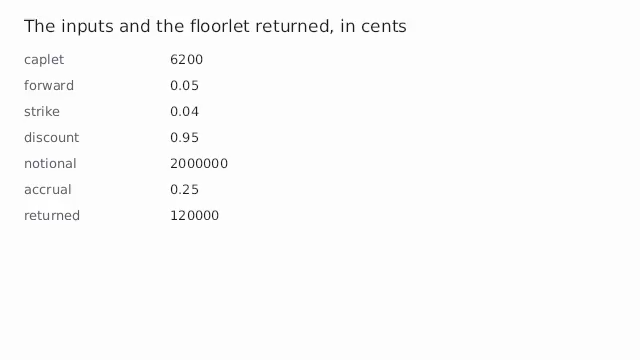
A caplet is quoted at a given value, not necessarily the model's. The program below is meant to return, in whole cents, the value of the floorlet with the same strike, period and payment date that parity implies: the caplet's value minus the value of the forward, which is notional times accrual times discount factor times forward minus strike. Decide whether it does, and find the candidates that do. Check runs each candidate on the data shown and on five others.
let scale = notional * accrual;
let forward_value = scale * (forward - strike);
let answer = int(math_round(lmf.round(caplet - forward_value, 2) * 100.0));
{
  "answer": 120000
}
A caplet and a floorlet have the same strike, period and payment date. The caplet is quoted at caplet. Return, in whole cents, the floorlet's value that parity implies: the caplet minus the forward value, which is notional times accrual times discount times the difference of forward and strike. Round the result to cents.
Read the result carefully
The parity needs no volatility and no distribution of the rate, only that the two options have the same strike, period and payment date and that both are priced with the same discount factor. A quote that breaks it, where the floorlet implied by parity would be negative, is a sign of a bad quote in this model, not an opportunity the page recommends.
The two prices separately do need the model: Black's formula with one volatility. The inputs are made up, including the discount factor, and the page says nothing about real quotes. Amounts are rounded to cents because the engine's numbers are binary floating point. It is a description of an arithmetic model and not investment advice.
Recap
- Caplet minus floorlet, same strike and period, is the discounted forward rate minus the strike, times notional and accrual.
- The volatility drops out of the difference.
- The difference crosses zero where the strike equals the forward rate.
- It is put-call parity applied to a rate.