An Option on the Average
An average-price (Asian) option pays on the average of the prices at its fixing dates instead of the last price, so one extreme day counts for little; the demo prices one made-up path with the arithmetic and the geometric average and the plain call.
The question
A plain call pays on the last price, so one extreme price on the last day decides everything. An average-price option, called an Asian option, pays on the average of the prices at a list of fixing dates. Which prices belong to the average, how is the payoff computed, and how does it compare with the plain call on the same path?
The lesson works on one made-up path. The numbers are assumptions of the lesson, not data about any market.
Work it by hand
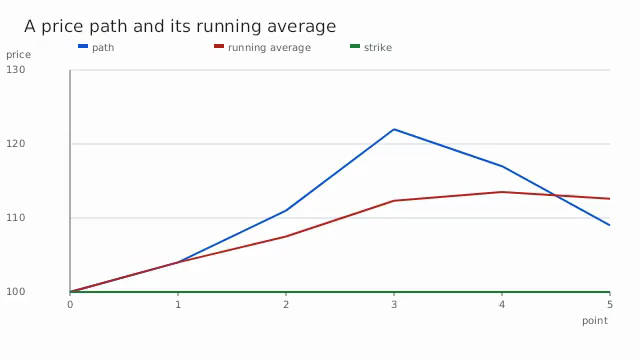
Take the path 100, 104, 111, 122, 117, 109 and the strike 100. In the contract of this lesson the fixings are the points after the first: today's price, 100, is the starting point and is not part of the average. The five fixings are 104, 111, 122, 117 and 109.
Their sum is 563 and their average is 563 / 5 = 112.6. The arithmetic average-price call pays the average minus the strike, if that is positive: 112.6 - 100 = 12.60. The plain call pays the last price minus the strike: 109 - 100 = 9.00.
The 122 on the fourth point raised the average by 1.0 compared with a 117 there (5 spread over five fixings), and it does not touch the plain call at all. The geometric average, the fifth root of the product of the fixings, is never above the arithmetic one, so the geometric call pays no more.
Run it
Line 1 counts the fixings, one fewer than the points. Lines 2 to 4 build the arithmetic and the geometric average-price call and the plain call, all with a one-year life; the engine's payoff on a path is the average of the points after the first minus the strike, with a floor of zero. Lines 7 to 13 build the running average for the picture: at the first point the line starts at today's price, which is not part of the average.
let n = path.len() - 1;
let ar = instrument.asian_call(strike, 1.0, "arithmetic", n);
let ge = instrument.asian_call(strike, 1.0, "geometric", n);
let plain = instrument.european_call(strike, 1.0);
let step = float_list(); let avg = float_list(); let line = float_list();
let total = 0.0;
for (i in range(0, path.len())) {
  step.add(float(i));
  line.add(strike);
  let mean = path.at(0);
  if (i > 0) { total = total + path.at(i); mean = total / float(i); }
  avg.add(lmf.round(mean, 4));
}
lmcode_return_put("step", step);
lmcode_return_put("path", path);
lmcode_return_put("average", avg);
lmcode_return_put("strike", line);
lmcode_return_put("geometric", lmf.money(ge.path_payoff(path)));
lmcode_return_put("plain", lmf.money(plain.path_payoff(path)));
let answer = int(math_round(lmf.round(ar.path_payoff(path), 2) * 100.0));
{
  "answer": 1260,
  "step": [
    0,
    1,
    2,
    3,
    4,
    5
  ],
  "path": [
    100,
    104,
    111,
    122,
    117,
    109
  ],
  "average": [
    100,
    104,
    107.5,
    112.3333,
    113.5,
    112.6
  ],
  "strike": [
    100,
    100,
    100,
    100,
    100,
    100
  ],
  "geometric": "12.43",
  "plain": "9.00"
}
Line 20 returns the arithmetic payoff in whole cents, rounded with lmf.round: 1260. The recording shows the geometric payoff 12.43 and the plain call 9.00.
You can change the path and the strike. The path needs at least two prices: a path of one point stops line 2 with "Line 2: fixings must be 1..10000". Every price must be positive: a price of 0 stops line 18 with "Line 18: Option.path_payoff: prices must be positive, got 0 at index 1".
The strike must be positive: a strike of 0 or less stops line 2 with "Line 2: option strike must be positive". A list holds at most 64 numbers. The number of fixings in the option is not compared with the path: line 1 is what ties them.
Your turn
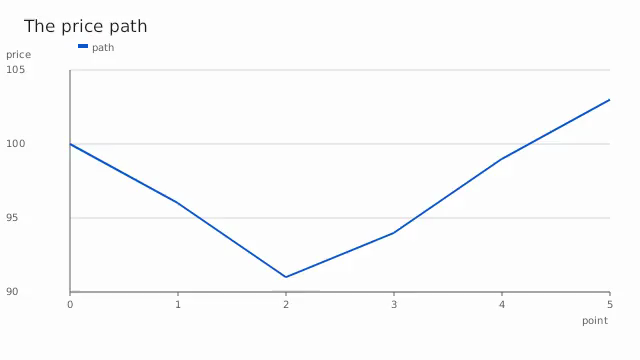
The list path holds a price path, today's price first, and strike is the strike of an arithmetic average-price put, which pays the strike minus the average if that is positive. The fixings are the points after the first. The program below should return the payoff in whole cents. Decide whether it does, and find the candidates that do. Check runs each candidate on the data shown and on six others.
let total = 0.0;
for (i in range(0, path.len())) { total = total + path.at(i); }
let mean = total / float(path.len());
let put = instrument.european_put(strike, 1.0);
let answer = int(math_round(lmf.round(put.payoff(mean), 2) * 100.0));
{
  "answer": 783
}
path holds a price path, today's price first. The fixings are the points after the first. An arithmetic average-price put with the strike strike pays max(strike - average of the fixings, 0), one-year life, not discounted. Return the payoff in whole cents.
Read the result carefully
Which dates are fixings, and whether today's price is one of them, is a term of the contract. Here the fixings are the points after the first, and the average is simple, every fixing with the same weight. A real contract can differ in both.
The payoffs on this page are on one made-up path, not discounted, and say what the option would have paid on that path, not what it is worth. On this path the geometric call pays less than the arithmetic one; on every path it pays no more. It describes a model on made-up inputs and is not investment advice.
Recap
- An Asian option pays on the average of the prices at its fixing dates.
- Here the fixings are the points after the first; today's price is not one of them.
- One extreme price moves the average much less than it moves the last price.
- The geometric average is never above the arithmetic one, so its call pays no more.